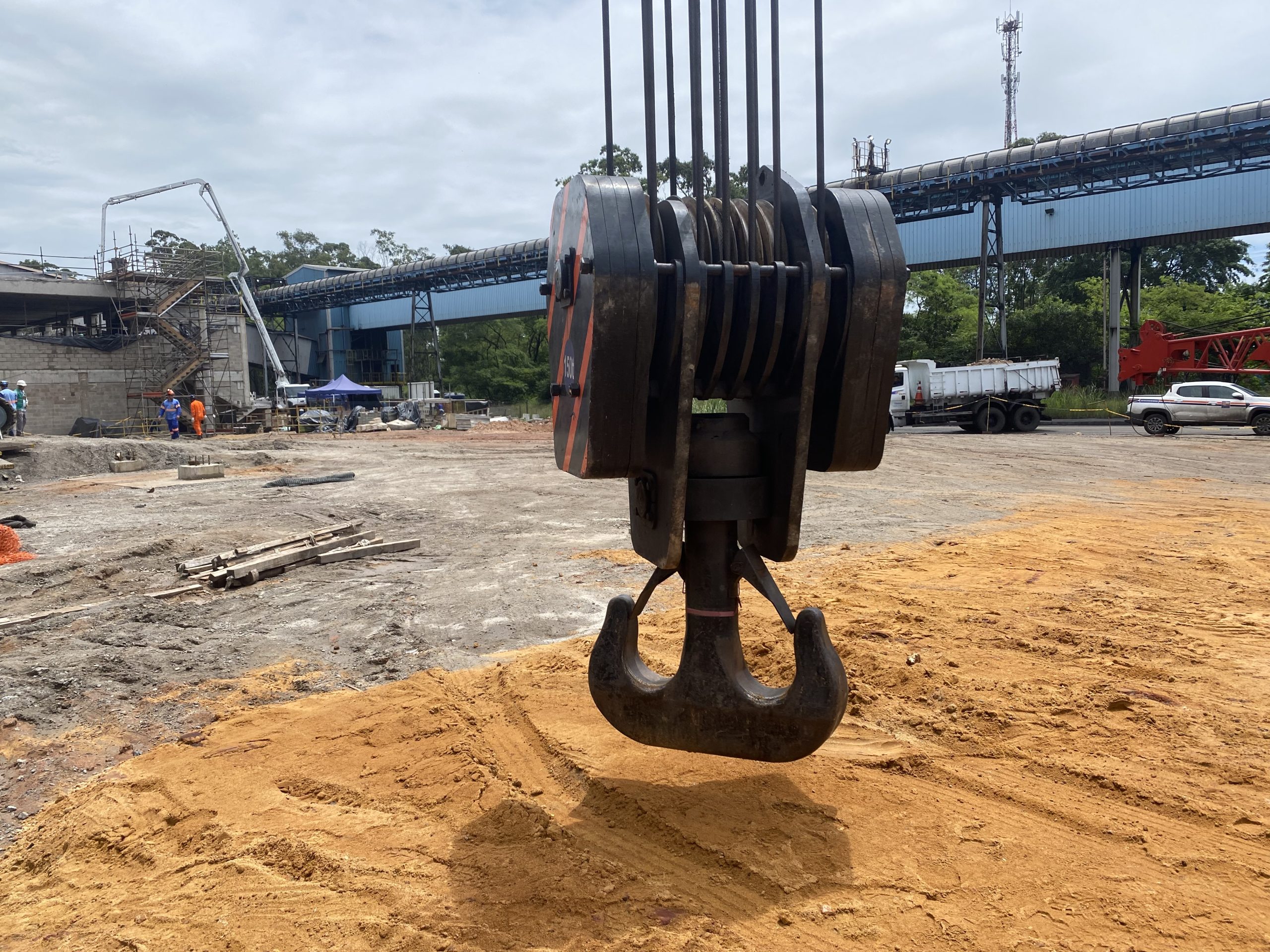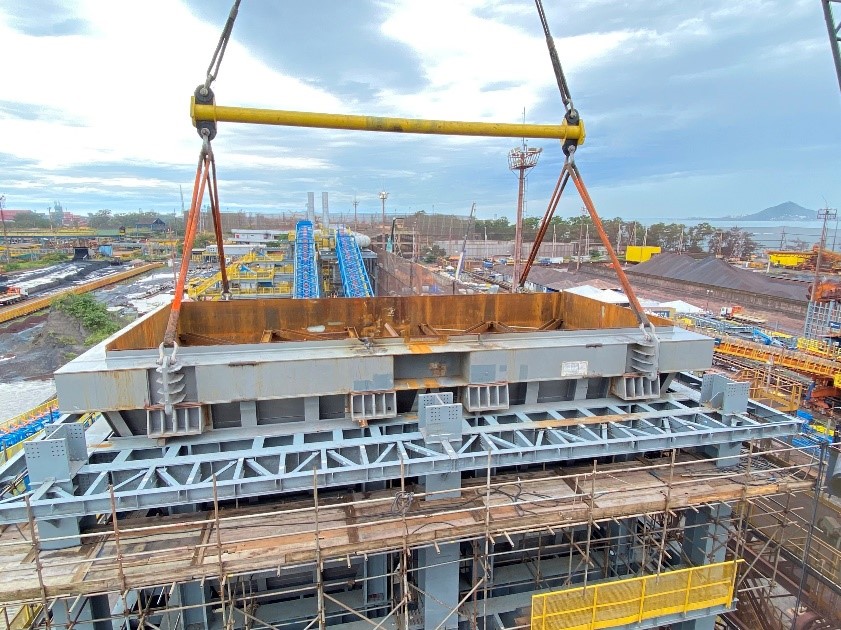

When using a four-leg sling, certain factors often cause the load to be distributed across only the two shortest legs, which are diagonally opposed.
When the load is significant (exceeding 1 tonne), it is impossible to manually verify if any legs are slack, creating a false impression that the load is shared equally.
In these cases, load cells can be used to verify the tension in each leg.
Check out our experiment:
- We used four Eilon Engineering Ron StageMaster 6000G5 (3 t) load cells, positioning one per leg (https://www.eilon-engineering.com/).
- We used a 4-leg chain sling with all legs connected to a shackle. This caused the length to the lifting points to be slightly different, simulating the unavoidable differences among legs due to standard length tolerances.
- The sling legs were adjusted to have the same nominal length.
- We connected the slings to a very rigid load weighing about 700 kgf.
- We lifted the load.
- We checked the legs by hand and found that two of them were slack.
- We checked the values on the load cell software, which showed 348 kgf, 303 kgf, 23 kgf, and 18 kgf, confirming that only two legs were carrying the entire load.


FACTORS THAT AFFECT FORCE DISTRIBUTION IN THE LEGS
- Structural stiffness of the load: The stiffer the load, the more the force will be concentrated in the two shortest legs.
- Length differences between sling legs: The greater the difference, the less equitable the load distribution.
- Dynamic forces: These lead to noticeable slack in two legs, particularly during offshore lifting operations.
HOW TO DESIGN 4-LEG SLINGS
- Most conservative approach: Consider only two legs as load-bearing, with the others merely balancing the load.
- Standard simplification (Codes and Standards): Consider three legs as load-bearing (use with caution!).
- Optimized approach: Perform a non-linear structural analysis, taking into account both load and sling stiffness.
- Real-time monitoring and adjustment: Account for forces in all four legs by monitoring with load cells and adjusting leg lengths using turnbuckles, chain hoists, lever hoists, etc.
All images by Leonardo Roncetti.