
Article published in Crane Brasil magazine no. 99. Access it here!
Slings, whether made of steel wire rope, synthetic webbing, chain, or other materials, are fundamental elements for lifting operations, serving as a connection between the load and the hoisting equipment, or as a link to other slings or accessories.
The almost unlimited geometry of the loads to be lifted presents challenges to the professionals who select, size, and detail the slings. Therefore, having effective calculation tools that facilitate these actions will bring safety and operational efficiency to load handling plans (rigging plans).
For the sizing or verification of slings, there are several established methods, such as the tabular, trigonometric, use factor, structural analysis, and others, each with its ease of implementation and results ranging from optimized to very conservative.
The following table summarizes three of the main methods used by Brazilian standards.
| Method | Advantages | Disadvantages | |
| Tabular Method | It uses tables with Working Load Limit (WLL) (or EWLL) values for the most common sling configurations, varying the hitch type and the angle of the legs, generally adopting 45° and 60° from the vertical. | It requires no calculation to determine the WLL (or EWLL); a simple consultation based on the geometry and the sling’s reference parameter is sufficient, which can be the vertical WLL for synthetic webbing, or the diameter for wire rope or chain. | Limitation of variations in configurations and angles between legs. Requires a table for every variation of parameters for wire rope slings (type of core, strength grade, etc.). High probability of errors in the table due to typing or editing mistakes. Can lead to oversizing at boundary values, such as a 46° angle from the vertical, where the 60° column must be used in the table, significantly reducing the WLL (or EWLL). |
| Trigonometric Method | In wire rope slings, formulas are used that consider the cable’s breaking load, terminal efficiency, and sling geometry to determine the WLL (Working Load Limit). | There is no need to consult tables, as all necessary parameters are obtained based on the rope diameter, strength class, and terminal type. Ideal for application in electronic spreadsheets or computer programs. The WLL can be determined for any sling configuration from 1 to 4 legs. | Longer time required for implementation. Difficult implementation for synthetic webbing and chains. |
| Use Factor (UF) Method | It uses a simple mathematical formula with tabulated WLL (or EWLL) parameters for vertical sling lifting. | Fast determination of the WLL (or EWLL). Immediate determination of the force acting on the sling leg and on the accessories connected to the legs. | In the case of wire rope and chain slings, they depend on knowing the WLL value for vertical lifting. Need to consult use factors for choke hitches, asymmetrical slings, and additional calculation if there is bending of the wire rope body. |
As shown in the methods table, the Use Factor method combines the advantages of both the tabular and trigonometric methods when the vertical WLL value is available, which can be obtained from simplified tables, labels, or the sling’s identification plate.
The Use Factor method’s parameters are the inclination angle of the sling legs, the number of legs, and the sling’s WLL for a vertical lifting configuration. Therefore, we have:
UF = N x Sen θ (Eq. 1)
EWLL = WLL x FU (or Eq. 2)
EWLL = WLL x N x Sen θ (Eq. 3)
Where:
- UF: Use Factor.
- EWLL: Effective Working Load Limit of the sling for the proposed configuration.
- WLL: Working Load Limit of a 1-leg sling for vertical lifting. It can be obtained from technical standards tables or the manufacturer’s catalog.
- N: Number of sling legs, being 1 for a 1-leg sling, 2 for a 2-leg sling, and 3 for a 3 or 4-leg sling.
- θ: Angle of the sling leg relative to the horizontal.
Notes:
- The angle θ is referred to in relation to the horizontal and not the vertical. Technical standards frequently adopt the vertical reference.
- NBR 15637 distinguishes between WLL (CMT) and EWLL (CMTE). The WLL is the working load limit for a single-leg sling in a vertical lift, which serves as the reference value for all other calculations. The EWLL is the working load limit for other configurations by applying the use factor to the WLL: choke hitch, two, three, or four legs, 2 legs with a choke hitch, etc.
- NBR 13541-1 and NBR 15516-1, which cover wire rope slings and chain slings respectively, do not distinguish between WLL and EWLL, simply using the term WLL.
- Brazilian sling standards calculate their tables based on the Use Factor.
Application Examples
Example 1: What is the WLL of a symmetrical wire rope sling with a fiber core, 19 mm diameter, 1770 strength grade, with 2 legs at a 60° angle to the horizontal (θ = 60°)?


Based on the excerpt from Table 3 of NBR 13541-1 (2017), first, let’s determine how to obtain the WLL value for 2 legs at a 45° angle, which has a tabulated value of 5.3 t.
UF45°,2p = N x Sen θ = 2 * Sen 45° = 1.4
WLL45°,19mm = WLLVert,19mm x UF45°,2p = 3.8 x 1.4 = 5.3 t
Now, we calculate the WLL for the 60° angle relative to the horizontal:
UF60°,2p = N x Sen θ = 2 * Sen 60° = 1.73
WLL60°,19mm = WLLVert,19mm x UF60°,2p = 3.8 x 1.73 = 6.5 t
Therefore, if we were to use the tabular method, the WLL for 60° to the horizontal would be 5.3 t, because the standard’s table does not present a value for this specific angle. By using the specific UF for 60° to the horizontal, we optimize the WLL value to 6.5 t. This represents a 22% gain.
The WLL value of 6.5 t means that with a 2-leg sling at a 60° angle to the horizontal, we can lift a mass that induces a maximum force of 6.5 tf in the sling; dynamic effects and possible weight variations must be part of this force.
To size the shackle that connects one of the legs to the load, simply choose it according to the WLL of a 1-leg sling.
WLLshackle ≥ WLLVert,19mm ≥ 3.8 t
Therefore, we can choose a shackle with a WLL of 4.75 t, as the maximum force in one leg will not exceed 3.8 tf.
Now that we have the UF for a 60° angle to the horizontal (UF = 1.73), we can calculate any WLL for other diameters:
WLL60°,16mm = WLLVert,16mm x UF60°,2p = 2.7 x 1.73 = 4.6 t
WLL60°,14mm = WLLVert,14mm x UF60°,2p = 2.1 x 1.73 = 3.6 t
WLL60°,13mm = WLLVert,13mm x UF60°,2p = 1.7 x 1.73 = 2.9 t

Example 2: Now, if we have a 4-leg sling with the same characteristics, with θ = 60°, we simply change the value of N to 3.
UF60°,4p = N x Sen θ = 3 x Sen 60° = 2.59
WLL60°,19mm = WLLVert,19mm x UF60°,4p = 3.8 x 2.59 = 9.8 t
The shackle for this configuration is the same as for the 2-leg sling, as the maximum force remains 3.8 tf in each leg.
For synthetic webbing slings, the procedure is exactly the same.
Example 3: Assuming the case in Figure 4, using webbing slings with a vertical WLL of 80 t, what would be the EWLL of the 2-leg sling on each side of the spreader beam for a 60° angle?
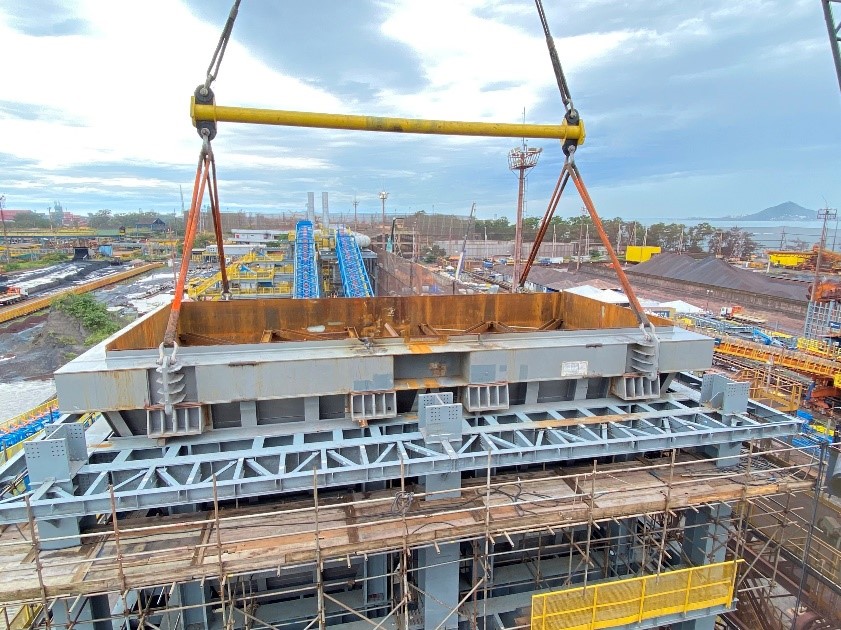
One of the advantages of synthetic webbing is that we do not need to consult a table to find the vertical WLL; we simply choose the one we wish to use.
Note that the Use Factor is independent of the sling material type, working for wire rope, synthetic webbing, chain, or any other material.
Let’s calculate the EWLL for this 2-leg sling at 45° and 60° relative to the horizontal.
EWLL45°,80t = WLLVert,80t x UF45°,2p = 80 x 1.4 = 112 t
EWLL60°,80t = WLLVert,80t x UF60°,2p = 80 x 1.73 = 138 t
WLLshackle ≥ WLLVert,80t ≥ 80 t
Note that, for both cases, the shackle remains the same, as the maximum force on the leg is limited to the value of the vertical WLL (WLLVert, 80t); that is, we will never use a leg more loaded than the limit of a 1-leg sling.
If the 4 webbing slings were connected directly to a single hook, we would have a 4-leg configuration. Since we already calculated the UF for 60° and 4 legs in Example 2, all that remains is to calculate the EWLL:
EWLL60°,80t = WLLVert,80t x UF60°,4p = 80 x 2.59 = 207 t
Should we wish to use these slings at a 45° angle, we calculate the new Use Factor, the EWLL, and the force on the shackle:
UF45°,4p = N x Sen θ = 3 x Sen 45° = 2.12
EWLL45°,80t = WLLVert,80t x UF45°,4p = 80 x 2.12 = 169 t
WLLshackle ≥ WLLVert,80t ≥ 80 t
Through these examples, the ease of calculating the WLL of slings using the Use Factor method was demonstrated, which can be applied both to the sizing and verification of slings made of various materials.
As a final recommendation, in the calculation of the EWLL, the preference is to consult the vertical WLL (WLLVert) values in technical standards tables.
The full article can be read in Crane Brasil magazine, issue no. 99.

GEOMETRY AND EFFECTIVE WORKING LOAD LIMIT OF ASYMMETRICAL SLINGS
2-leg slings are widely used in various lifts, and symmetrical ones are extremely easy to calculate. However, when the center of gravity (CG) is offset from the center of the lifting points, an asymmetrical sling must be used, the calculation of which is not trivial.
In this “How to Calculate,” the formulation for determining the geometry and Effective Working Load Limit (EWLL) of asymmetrical slings with leveled lifting points and uneven lifting points is presented.
Based on this information, it is possible to determine an arrangement that results in a leveled load lift, as well as to size the shackles, master link, and lifting points.
Starting with the geometry, we have the two situations illustrated in Figure 1. The formulation for leveled lifting points is a specific case of uneven points, by setting H1 = H2 = H; the reader may choose to work solely with the formulation of the latter.

Where:
- A and B are the horizontal distances from the lifting points to the center of gravity.
- H, H1, and H2 are the vertical distances from the lifting points to the intersection point of the leg axes.
- La and Lb are the leg lengths plus the length of the shackles.
- a and q are the angles of the legs relative to the horizontal.
In this article, it is assumed that angle $\theta$ is always greater than angle $\alpha$, ensuring that leg “b”, which is closest to the CG, will always be the most heavily loaded.
Assuming that dimensions A, B, H1, and H2 are known, the inclination angles relative to the horizontal are determined:
α = tan-1
θ = tan-1
Based on the angles or the other dimensions, the lengths of the legs and shackles are determined:
La = or La =
Lb = or Lb =
For slings with leveled lifting points, simply replace H1 and H2 with H in the equations above.
Once the geometry is determined, the “use factor” method is used to calculate the Effective Working Load Limit of the sling as a function of the vertical WLL of the sling used for leg “b” (WLLb).

EWLL = WLLb
EWLL ≥ Fs
Where:
- EWLL is the Effective Working Load Limit of the asymmetrical sling.
- WLLb is the reference Working Load Limit in its simple vertical form for leg “b”.
- Fs is the total force that the load applies to the sling.
Note 1: The trigonometric expression for EWLL is the use factor (UF), a constant for a given geometry, used for the immediate calculation of the EWLL for slings of any material—whether wire rope, synthetic webbing, chain, HMPE rope, or other materials—simply by multiplying this factor by the vertical WLL of a single-leg sling.
UF =
Note 2: The EWLL equation above represents the general case for a 2-leg sling, where the symmetrical EWLLsym is a specific case in which a = q. By substituting this, we have:
EWLLsym = WLLb= WLLb 2sen(θ)
The expression 2 sen(θ) is precisely the use factor for a 2-leg symmetrical sling.
Note 3: Technical standards for slings do not explicitly cover the use factor for asymmetrical slings. Furthermore, they adopt angle b as a reference, which is the complement of the angle relative to the horizontal:
β = 90º – θ
The reader must perform the proper conversions when referring to the leg angles.
Numerical Example
The 2-leg asymmetrical sling shown in Figure 3 will be used to lift a load that transmits 10.0 t to the sling (Fs = 10.0 t, including dynamic factors, contingency, CG offsets, etc.). Calculate which wire ropes and synthetic webbing slings must be used so that the EWLL is compatible with the load. Also, calculate the required shackles and the master link.

Calculation of the Use Factor
UF = = = 1,37
With the UF value, you search the standard for the specific type of sling adopted to find the WLLb that satisfies the EWLL, or you can determine the minimum required WLL.
EWLL = WLLb UF ≥ Fs
WLLb ≥ ≥ ≥ 7,3t
Therefore, the chosen sling must have a minimum WLL of 7.3 t.
Using a wire rope sling with an independent wire rope core (IWRC), 1960 strength class, and 6×19 or 6×36 construction, reference Table 5 of NBR 13541-1. In the “single leg” column, select a diameter corresponding to a WLL value greater than or equal to 7.3 t. In this case, it corresponds to the 26 mm diameter rope, with a WLL of 8.1 t.
Thus, the EWLL of the asymmetrical wire rope (WR) sling can be calculated:
EWLLWR = WLLb UF = 8,1 * 1,37 = 11,0t > 10,0t
Therefore, the 26 mm diameter rope is suitable. Testing the next smaller rope diameter (22 mm, WLL 6.1 t), it is clear that it does not meet the load requirements:
EWLLWR = WLLb UF = 6,1 * 1,37 = 8,3 < 10,0t
To calculate the EWLL of the flat synthetic webbing sling (WS), reference NBR 15637-1 and choose a sling with a WLL greater than or equal to 7.3 t, which in this case is the blue sling with an 8 t WLL. Then, the EWLL is calculated:
EWLLCT = WLLb UF = 8,0 * 1,37 = 10,9T > 10,0t
For the shackles, simply adopt those with a WLL greater than or equal to the WLL of the most heavily loaded leg. In this example, for both the wire rope sling and the synthetic webbing sling, the minimum shackle would be one with an 8.5 t WLL. Note that for the final definition of the shackles, you must also verify the geometric compatibility with the sling eye and the load lifting eye.
If the sling has a master link, it must have a WLL greater than or equal to the EWLL, which in this case is 11 t.
Final Considerations
The use factor method allows for the simple calculation of the EWLL of slings made of various materials based on the reference WLL of a single vertical leg.
In this formulation, it was considered that the angle of the leg relative to the horizontal, on the side closest to the CG, is always greater than the angle of the other leg. This ensures that the closest leg will always be the most heavily loaded.
Although the two legs of the sling have different lengths, they must be identical in composition, being governed by the one with the highest demand. This also applies to the accessories at the lifting points.
The full article can be read in Crane Brasil magazine, issue no. 102.